
in your cart

Total amount
Show cart
( items)

| Item No. | Vørunavn | Eind | Mynd | Prísur v/MVG |
|---|
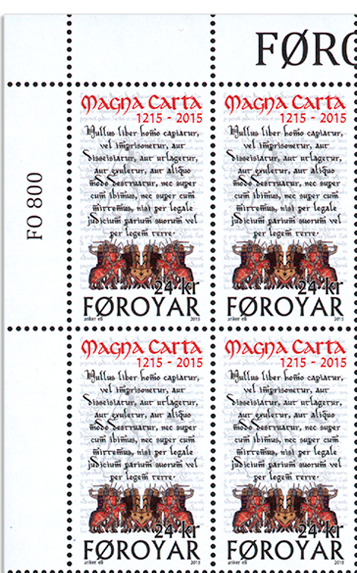
In June 2015, 800 years have passed since one of the world's most important documents, the Magna Carta was sealed.
Issue Date: 2/23/2015
Item No.: PPB000800
Value: 96,00
Magna Carta 800 years. Date of issue: 23.02.2015. Value: 24,00 DKK. Number: FO 800.
Stamp size: 24,9 x 42 mm. Design: Anker Eli Petersen. Printing method: offset.
Printer: Cartor Security Printing, France. Postal use: medium letters tol Europe, 51 - 100 gr.
Magna Carta 800 years
In June this year, 800 years have passed since one of the world's most important documents, the Magna Carta was sealed in a meadow at Runnymed in Berkshire. The document was the result of an agreement between King John I and the barons who had rebelled against his oppressive regime.
King John I
When King Richard I (Richard Lionheart) died in 1199, his younger brother John (1166-1216) became king of England. The kingdom also included Ireland and large parts of western France. In 1202 war broke out between King John and King Philip II of France (1165-1223), which led to the loss of the French possessions in 1204.
The following decade King John spent his energy and resources to win the lost possessions back. After the final defeat for the king and his allies at Bouvines in 1214, he had lost all confidence and created so much animosity and fear among his henchmen, the barons that they revolted against him.
The Barons Revolt
King John's war with the French had left England in turmoil over increased taxes and regular repression. Discontent with the king was widespread and eventually led to downright revolting. When King John came back after the decisive defeat at Bouvines in 1214, he was met with demands for reform from a majority of the barons and noble men, who otherwise constituted the core of his power. The parties met at Runnymede on Thames, between Windsor and Staines - and it was here that “The Article of the Barons” - the first draft of the Magna Carta – was imposed upon the king and confirmed with the king's Great Seal.
Magna Carta
The revolutionary idea of the Magna Carta was that there for the first time was an attempt to limit the powers of the king. The idea was to issue an inviolable law which included the Crown, and prevent the king from exploiting his powers. It contained passages on individual and group rights and even went so far as to suggest the possibility of depriving the King of his powers, if he should exceed the rules of his governance.
There are 63 clauses in the original version of the Magna Carta. Most of them concerning the regulation of feudal practices, provisions of cities, trade and the royal forests. Additionally, there are provisions for the settlement of debts and the rights of the church. But the most important clauses deal with the individual's legal rights against the state - and the limitation of royal power.
King John never complied with the requirements of the Magna Carta and within three months, he got Pope Innocent III to declare the letter's provisions illegal. But the seeds were sown. Magna Carta's content had been spread all over the country and had taken root. A civil war broke out, in which most of the barons fought for the principles of the Magna Carta. They convinced the French Crown Prince Louis to accept to become King of England and the Scottish King Alexander II to occupy the north of England.
In 1216, when most of the country was under rebel control, King John suddenly died of dysentery. The King's few remaining supporters and the Pope's representative decided to proclaim his nine year old son Henry King of England. They sent letters to the leaders of the rebellion in the name of the new King, in which they confirmed the provisions of the Magna Carta and urged the barons to swear allegiance to Henry III. At this time some friction had appeared between Louis and the rebels, and many of the barons therefore changed side and supported the child King.
Follow-ups
In the following years, until King Henry reached legal age, Magna Carta was confirmed and rewritten several times. The letter became known throughout the country and the ideas widely accepted. The controversial clause that the king could be deposed by the barons, was, however, soon removed.
But in the following decades the barons gained greater influence. In 1258, a group led by Simon de Montfort, imposed the so-called Oxford provisions, where the King was in fact subject to a council of chosen men.
Although the Magna Carta in the following time underwent major changes, and the baron’s power over the King was removed by a royal offensive, led by Crown Prince Edward, many of the reforms remained, even after Edward became king. The local assemblies, manned by the gentry, landowners and village-representatives, survived - and during the fourteenth century these assemblies and their counterpart, the nobility of the royal circles, evolved into something similar to today's bicameral parliament, the House of Commons and the House of Lords.
The legacy of Magna Carta
Magna Carta's basic ideas appeared again and again in the development of the English state administration throughout the centuries - and even spread beyond the British borders. The way in which our own Constitution divides the authority into legislative, judicial and executive branches, can be partly traced to the hastily formulated document from an insignificant English meadow in 1215 AD.
The text in the background on the stamp is a transcript of a part of the infamous 61th clause, which sought to limit the King's powers. In the front of the stamp, we have reproduced the most well-known passage from the original Magna Carta letter:
“No free man shall be seized or imprisoned, or stripped of his rights or possessions, or outlawed or exiled, or deprived of his standing in any other way, nor will we proceed with force against him, or send others to do so, except by the lawful judgement of his equals or by the law of the land.“
Anker Eli Petersen
The background of the stamp is a transcript of parts of the 61st clause in the original Magna Carta of 1215. This clause declares that the barons should be able to overthrow the king or put him under administration if he exceeds his powers. The 61st clause was, as you might expect, removed from later versions of the Magna Carta - but it is the seeds of the constitutional monarchy we know today.
Along with the text, King John's Great Seal is depicted.
The black text on the stamp is a transcript of the 39th clause which says that no free man should be prosecuted by others than an independent court - and according to the laws of the land.