
in your cart

Total amount
Show cart
( items)

| Item No. | Vørunavn | Eind | Mynd | Prísur v/MVG |
|---|

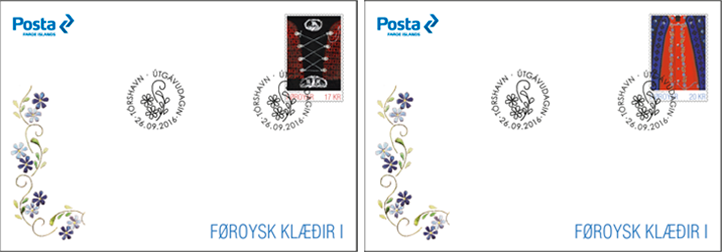
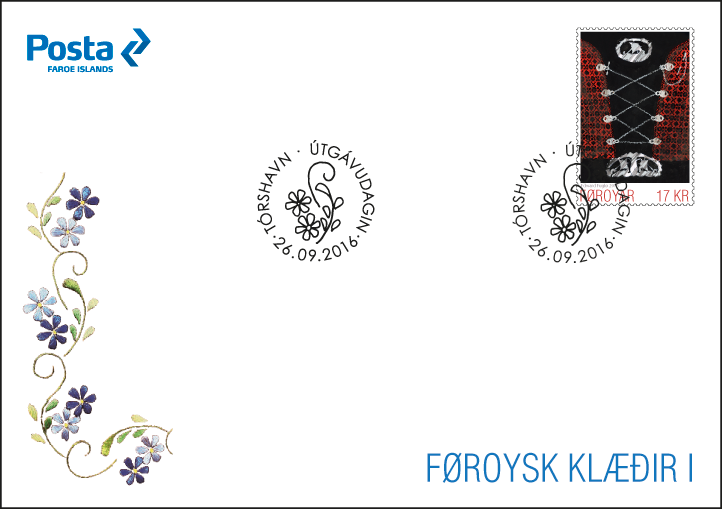
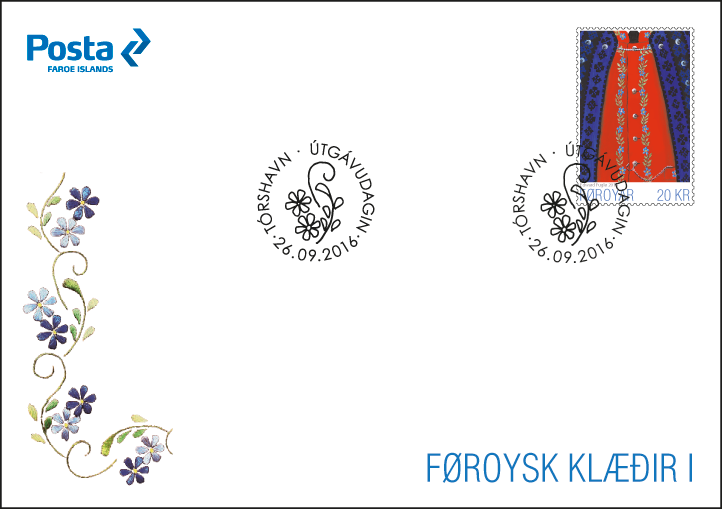
Many Faroese wear national costumes at parties and town festivals.
Issue Date: 9/26/2016
Item No.: FFL000916
Value: 44,00
Visitors to the Faroe Islands have hardly failed to
notice that many Faroese wear national costumes at parties and town festivals. They
will see men wearing breeches and the distinct Faroese hats and women in full-length
skirts with beautifully embroidered aprons and shawls, with elegantly made silver
jewellery.
In actuality, the Faroese national costume tradition is
not very old. The costumes are based on the way everyday clothing looked up until
the mid-19th century, and it was only during the national revival in the late 18th century that they started becoming
different from the commoner's clothing. The term "føroysk klæði"
(Faroese attire) should be compared to the concept "donsk klæði"
(Danish attire), which designated clothes bought in shops - and does not
necessarily denote formal wear. Gradually, as it became more customary to dress
in "shop's clothing" as most Europeans did, the traditional attire came
to occupy a class by itself. In my childhood we still could see men, especially
of the older generation, using breeches, knitted sweaters and hats in everyday
life.
Over time, and especially during the national romantic
revival in the late 18th century, the Faroese attire began assuming its
current status for festive occasions. There have been a number of changes made
from the original attire and a certain standardization of both female and male
dresses has taken place, so that one can now talk about a genuine national
costume. After World War II the use of the national costume gradually increased,
but in the last two or three decades it has come back with a vengeance, partly
because of nationalism flourishing due to the severe financial crisis in the
Faroe Islands in the nineties.
In three annual stamp issues we will illustrate
aspects of both the female and male costumes.
Torso - the female costume
The knitted blouse that goes with the female costume is
short and tight. It is open in front and has a wide neckline. Traditionally the
blouse is red with tiny black patterns or, more rarely, blue with dark blue
patterns. Recently, designers have started experimenting with colours - violet,
green or yellow, to name just a few.
A detachable bosom is worn underneath the open front of
the blouse. The bosom originates in the old festive apparel called
"stakkur" and was not being commonly used for this costume in the
past. In days of old the bosom was woven or knitted in wool, then fulled or
felted, while nowadays being made of lined velvet or similar fabric. The bosom
serves two functions - the first as a compensation, let's say if the woman gets
a little bigger, enabling her to use the same blouse. Its second function is to
serve as an underlay, enhancing the costume's silver ornament.
In order to tighten the blouse against the body, use
is made of a silver chain, a so-called "stimi". The stimi is pulled
through the eyelets, "malja" in Faroese, on both sides of the blouse
opening. A silver needle called "sproti" is at the end of the stimi which
is fastened to the blouse after insertion. A source reports that formerly the
stimi went up under the bust in order to accentuate it - but now it goes up on
the bust of the dress.
Around the waist women wear a wide black belt with
ornamented silver buckles. In rare cases, the entire belt is composed of
ornamented silver pieces.
A large ornamented silver brooch is on top of the detachable
bosom, used to hold the shawl in place. The brooch and belt buckles should
preferably match with each other.
On the whole, silver ornamentation plays an important
role in the national costume. There are women who, while their daughters are still
young, start collecting the single silver pieces which at some point in the
future will become a complete set. The silver ornamentation is also often
passed on from mother to daughter. The design of the brooch and the silver
buckles varies. In recent years Faroese decorative motifs have become more
frequent.
Torso - the male costume
Men dressing in the national costume generally wear a white
shirt next to the body. Over the shirt they wear a waistcoat with six silver
buttons, two small pockets and intricate floral embroideries. The waistcoat is
either red or black in front. There is also a white waistcoat variant used by bridegrooms
at weddings.
Over the waistcoat men wear a buttoned knitted sweater,
open in front with silver buttons on both sides. The sweater is mostly worn
open in front, held together at the top by a short silver chain with silver
buttons at each end. The buttoned sweater is either uni-coloured dark blue and made
of knitted and felted wool - or, as shown on the stamp, light blue with a dark
blue pattern.
Anker Eli Petersen