
in your cart

Total amount
Show cart
( items)

| Item No. | Vørunavn | Eind | Mynd | Prísur v/MVG |
|---|
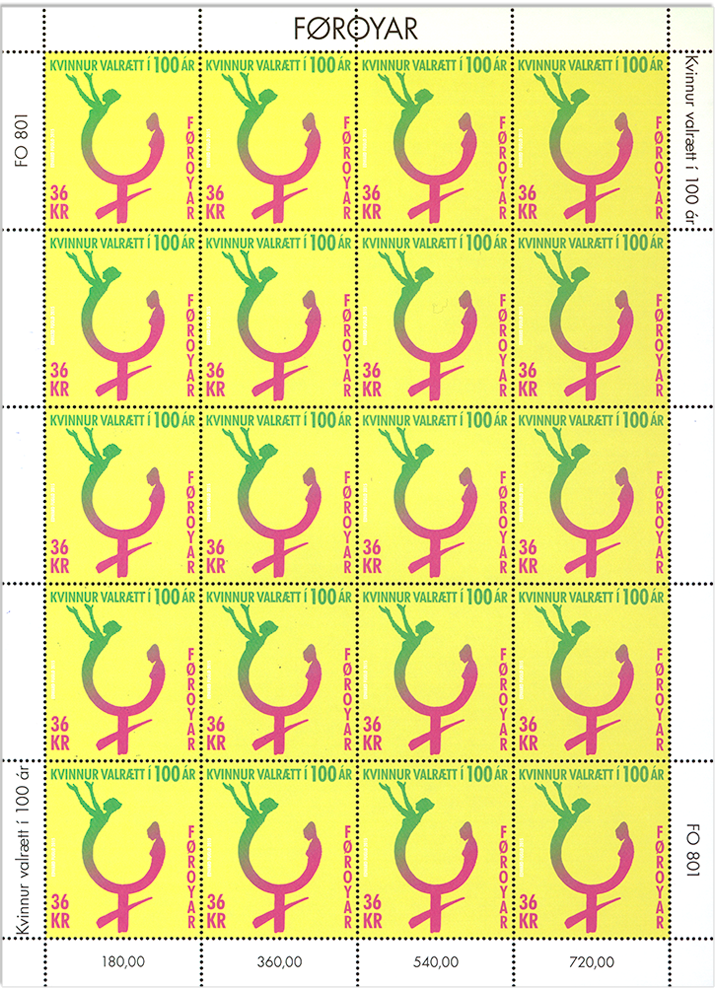
In 1915, Faroese women gained the right to vote for both houses of the Danish Parliament, the Folketing and Landsting.
Issue Date: 2/23/2015
Item No.: PPD000801
Value: 720,00
100 Years of Women's Suffrage. Date of issue: 23.02.2015. Value: 36,00 DKK. Number: FO 801.
Stamp size: 40 x 45 mm. Design: Edward Fuglø. Printing method: offset.
Printer: Cartor Security Printing, France. Postal use: large and medium letters to other countries, 51 - 100 gr.
100 years of women’s suffrage
In 1915, Faroese women gained the right to vote for both houses of the Danish Parliament, the Folketing and Landsting. On 5 June 1915, as part of an amendment of the Danish Constitution, women were granted the right to vote. The next year, the Faroese Parliament, known as the Lagting, adopted amendments to the parliament law that granted women the right to vote for the Lagting.
The first time Faroese women voted in a political election was the 1918 Lagting election. However, they had previously voted in a 1907 referendum on the liquor law, The Faroese Act on Trade in and Service of Intoxicating Beverages, which was a ban on serving alcohol in public venues. And women also had the option of voting in the 1909 municipal elections.
The roots of the women’s movement trace back to the United States in the mid-1800s. Women’s suffrage was a key demand from the very beginning. The ideas of this movement reached the Nordic region around the turn of the twentieth century and the Nordic countries were at the forefront of the fight for women’s suffrage.
The fight for women’s suffrage varied from country to country. In the United States, it was not a militant conflict as in England, where it was compared with a slave rebellion. The road to women’s rights and suffrage in each country depended how hard the men in power made the fight. In the Faroe Islands, there was no dispute about women’s rights and the battle for suffrage was first and foremost won in Denmark.
Despite receiving the right to vote, not many women were visible in the political arena for many years to come. Women’s conditions in society, particularly the labour market, underwent major changes in the 1960s, as women entered the job force in large numbers and became visible in political life.
In the rebellious 60s and 70s, the women’s movement fought to change the traditional view that naturally assigned men more rights and privileges in society, to foster solidarity between women and to reduce inequality between the sexes.
The foundation for women’s participation in political life was established in the 1970s. With female members of the Lagting, equality between men and women became a topic on the political agenda.
The first female MPs formed a group to help Faroese women become accustomed to female politicians. But the group was not permitted to hold meetings in the parliament building, on the grounds that the building was exclusively for “serious political tasks” and not for “fun and games”, as one MP put it.
The women’s group held meetings in other locations in Tórshavn from 1979 to 1983, with various themes and discussions. This grassroots work did not continue, however. Despite the women’s group not achieving its original goal of influencing the political parties’ work in the parliament, many of the group’s members became politically active and later ran for office in parliamentary and municipal elections.
The first female representative in the parliament was Malla Samuelsen for the Home Rule Party, in 1964. However, she was elected as an alternate and only served in office for a short time.
In 1978, the first women elected to the parliament were Jona Henriksen for the Social Democrats (she was also an alternate from 1975 to 1978) and Karin Kjølbro for the Republicans.
The first female minister was Jóngerð Purkhus, who became Minister of Finance and the Environment in 1985.
In 1993, the Faroese elected their first and only female prime minister, Marita Petersen of the Social Democrats, who held this office from January 1993 to September 1994. Later, Marita Petersen became the first woman elected president of the parliament. The first woman elected to represent the Faroe Islands in the Danish Parliament was Lisbet L. Petersen of the Unity Party, in 2001.
Ideas regarding political work have undergone major changes through these 100 years. The political tone was sometimes harsh and derogatory when talk turned to women’s suffrage and political participation 100 years ago.
But today, all of the political parties have a declared aim to ensure that women gain greater political representation. The non-partisan organisation Demokratia works to politically empower women. The Equality Act was the first pet project of Faroese female MPs and was passed in 1994, 15 years after the first women in the Lagting proposed the Equality Commission Act.
Women now have a natural place in political life. In 1978, two women were elected and in 1998 four women were elected. In 2012, nine MPs, or 27.3% of the Lagting, were women. On the other hand, only one of seven ministers is a woman.
Some political parties have committed themselves to gender equality in candidate nominations and there appears to be broad consensus on equality. But the step seems to be higher for women, while female MPs agree that it is necessary to continue efforts to increase women’s participation in politics.
Óluva Klettskarð