
in your cart

Total amount
Show cart
( items)

| Item No. | Vørunavn | Eind | Mynd | Prísur v/MVG |
|---|
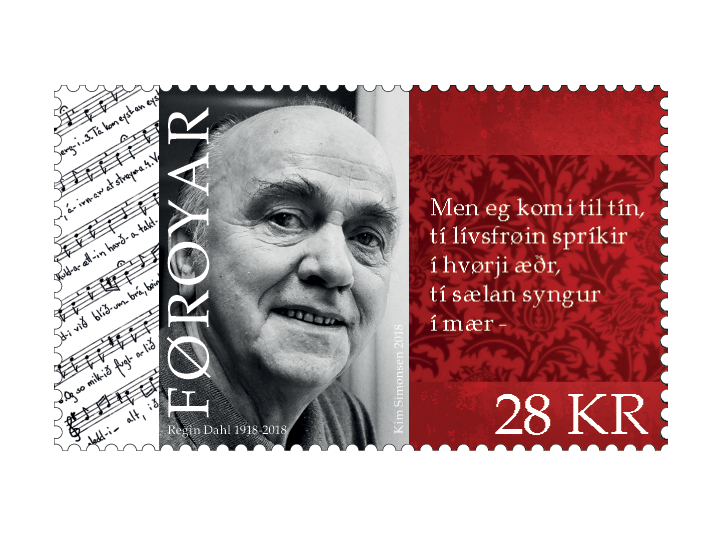
100 years ago, this year, Faroese poet, musician and translator Regin Dahl (1918-2007) was born in Sandágerði in Tórshavn.
Issue Date: 9/24/2018
Item No.: PPA000893
Value: 28,00
100 years ago, this year, Faroese poet, musician and translator Regin Dahl (1918-2007) was born in Sandágerði in Tórshavn. Regin Dahl graduated from Sorø Academy in 1937. Most of his life he worked as a publishing editor of the Gyldendal Publishing House.
Regin
Dahl received the M.A. Jacobsen's cultural award in 1973 and again in 1978. He
is also known in the Faroes for his groundbreaking work in Faroese music. In
1998, at the age of 80, he became the first Faroese to receive the Cultural
Award of the Faroe Islands.
Regin
Dahl's sense of the Faroese language came from his father, provost Jákup Dahl
who, among other things, had translated the Bible into Faroese. From his
mother, Maria Dahl, Regin Dahl inherited deep musical sensibility. Maria Dahl
was the daughter of the renowned musician Bager Hansen, whose bourgeois name
was Georg Caspar Hansen.
Regin
Dahl studied literature and Norse at the University of Copenhagen. His first
poem was published in the literary magazine Varðin in 1936. At the age of
eighteen, he made his debut with the poetry collection "Í útlegd" (In
Exile). The sense of exile was a consistent theme in his poetry, corresponding
to the fact that he lived all his life outside his homeland.
Regin
Dahl published eight collections of poetry. As a poet, Regin Dahl is an
important voice in Faroese literature and especially in Faroese lyricism. The
titles of the books display a superior knowledge of old Faroese language and
culture which he exposed to his literary modernism. An example of these titles
is "Eftirtorv" (Remnants of peat), indicating scraps of peat falling
off the load and lying scattered over the heath.
At
the inception of World War II connections between the Faroe Islands and Denmark
came to a halt. Regin Dahl was one of many young Faroese who stayed in Denmark
for their studies. When War came to an end in
1945 most of them went back to the Faroe Islands while Regin Dahl
remained in Copenhagen.
Regin
Dahl was an aesthete, poet, musician, translator and even more than that.
During his time of studies at Sorø Academy he gained many friends, including
the publisher Ole Wivel, who also became director of Gyldendal Publishing
House. Regin routinely associated with writers in these environments, including
those working for the journal Heretica. Wivel writes with a sense of tenderness
about this talented son of a Tórshavn provost:
"Already
in late summer 1946 I met Regin Dahl, who - without comments - was considered
among the core troops. (...) ... Both on the outside - as well as on the inside
- he bore a striking rememblance to Baudelaire. Small, dark, with a round head
(...) highly respected, a great musical talent, a true verbal genius and wine
lover with a Nordic melancholic temper and deep affection and yearning for his
islands in the Atlantic Ocean, he was unlike anyone that I had met."
Wivel,
1972, pp. 161-162.
One
of Wivel's memoirs "Dance of the Cranes" begins with the words:
"Leikum fagurt á foldum, / enginn treður dans undir moldum" (Let's
enjoy life while on earth, there is no dancing in the grave) – a lyrical
fragment originating from a Faroese folklore. Wivel's comparison of Regin Dahl
with Baudelaire is no conincidence since Regin is the Danish translator of
Baudelaire's diaries.
As a
publishing consultant Regin Dahl was involved in writing the history of Danish
literature. At the same time, he as a poet helped to reinvigorate both Faroese
lyric and its music-, culture- and literary history.
Kim
Simonsen