
in your cart

Total amount
Show cart
( items)

| Item No. | Vørunavn | Eind | Mynd | Prísur v/MVG |
|---|
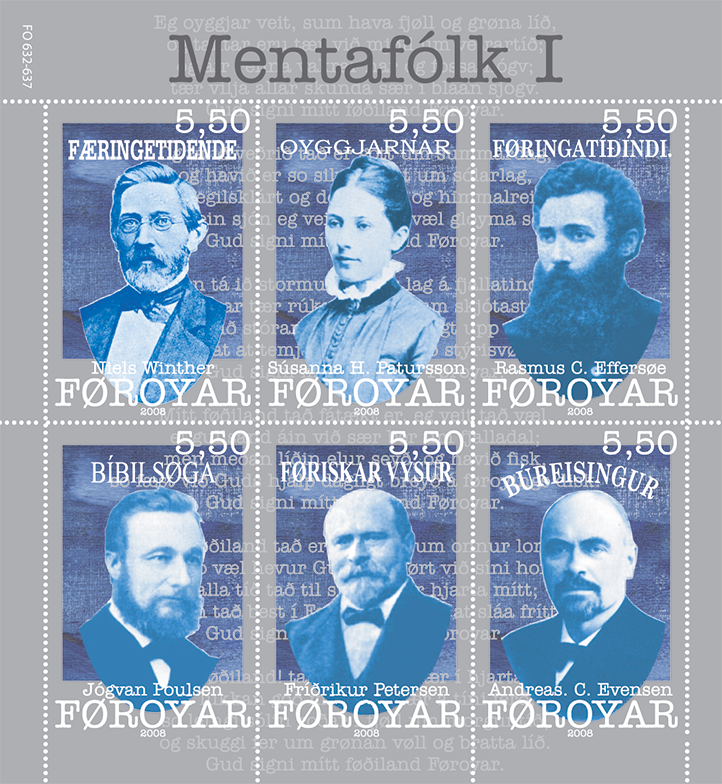
Sheetlet with six stamps of Faroese cultural personalities.
Issue Date: 5/19/2008
Item No.: PPS000508
Value: 33,00
Date of issue: 19.05.2008 - Value: 6 x 5,50 DKK - Numbers: FO 632-637 - Stamp size: 28 x 42 mm - Sheet size: 105 x 105 mm - Design: A.E. Petersen - Printing method: Offset - Printer: Cartor Security, France - Postal use: Inland letters up to 20 g.
►
Niels Christopher Winther (1822-1892)
Niels Winther was born in Tórshavn in 1822. Already as a child, he was very gifted. He came to Denmark while he was very young, where he became a law student. Back on the Faroes, Winther worked as a lawyer in Tórshavn. He was elected to the Danish Parliament in 1851 and became a member of the Faroese Parliament in 1852. In 1852 he started the newspaper “Færingetidende”, but because of his criticism of the Trade Monopoly, he had to stop again the same year.
Altogether the work of the progressive Winther became too difficult. Already in 1856 he stopped his political career, left the Faroes and settled in Hjørring, Denmark, where he lived and worked for the rest of his life.
Súsanna Helena Patursson (1864-1916)
Súsanna Helena Patursson was born in Kirkjubøur on Streymoy in 1864. She went to Denmark as a young girl to get an education, and worked after that as a legal secretary in Copenhagen. While in Copenhagen, she wrote the first Faroese play, a comedy called “Veðurføst” (1889), wrote some poems, two autobiographical short stories as well as articles in the newspapers “Føringatíðindi” and “Fuglaframi”.
In 1904 Helena moved back to the Faroe Islands and started the newspaper “Oyggjarnar” (The Islands). The first issue came on the 18th of April 1905. “Oyggjarnar” was written in Faroese and the main purpose was to provide Faroese material to the readers. The paper wrote, among other things, about women’s rights, women’s jobs and education, and emphasized the woman’s role in the national awakening. Other themes in “Oyggjarnar” were the importance of home decoration, health, fashion and misc. needlework. Because of lack of support and Helena’s deteriorating health, the paper stopped in 1908.
Rasmus C. Effersøe (1857-1916)
Rasmus Effersøe was born in Trongisvágur on Suðuroy in 1857. After secondary school in Tórshavn, he left the country to get an agricultural education in Denmark, Scotland and Sweden. He returned to the Faroes in 1884 and became agricultural counselor five years later.
Rasmus Effersøe was one of those men who arranged the historical Christmas Meeting in 1888, where “Føringafelag” (The Faroese Association) was founded. He became the first editor of the association’s newspaper “Føringatíðindi”. The main subjects of “Føringatíðindi” were Faroese language and culture, informative articles in Faroese, poetry, essays and domestic news. Already in his college years, Rasmus Effersøe proved to be a great poet, and his beautiful and optimistic patriotic songs are still popular at parties and gatherings. He still made poetry while he was the editor of “Føringatíðindi”, but gradually his poems became more pessimistic, marked by the ongoing quarrel in “Føringafelag”. Rasmus Effersøe also wrote several Faroese plays, his first was “Gunnar Havreki”, which was first performed in 1889, the same year as Helena Patursson’s “Veðurføst”. Besides “Føringatíðindi”, Rasmus Effersøe was also in periods editor of the newspaper “Dimmalætting” and “Dúgvan”, the paper of the temperance movement.
In the later years of his life, Effersøe was weakened by sickness, and he died in 1916.
Jógvan Poulsen (1854-1941)
Jógvan Poulsen was born in the small village Svínáir on Eysturoy in 1854. In 1874 he started on the Faroese Teachers College in Tórshavn and finished his education in 1876. He then became teacher in the village Strendur on Eysturoy.
Together with Chr. L. Johannesen in Tórshavn, he wrote the first Faroese school book “Förisk ABC” (Faroese Spelling Book), which was published by “Føringafelag” in 1891. The book was not used for long - the Faroese grammar was changed shortly thereafter and it was soon put in the shade by A. C. Evensen’s school books. But the achievement which Jógvan Poulsen is most known for, is his “Bíbliusøga” (Bible Story). This excellent book, which was published by “Føringafelag” in 1900, is a milestone in the Faroese literary history, both because it was written with the new Faroese grammar, and because it was the first modern religious book in a nation that still did not have its own translation of the Bible.
Jógvan Poulsen was also politician. He was a member of the Faroese Parliament from 1883 to 1923. After the first political parties were established in 1906, he represented the “Sambandsflokkurin” (The Unionist’s Party).
Fríðrikur Petersen (1853-1917)
Fríðrikur Petersen was born in 1853 in Saltnes on Eysturoy, where his father was a teacher. After secondary school in Tórshavn, Petersen tended high school in Reykjavík, Iceland, and then went to Copenhagen in Denmark to study theology. He graduated in 1880. The same year he became vicar on Sandoy, a few years later he became vicar in Suðuroy, until he finally was appointed Faroese rural dean in 1900 and moved to Nes in Eysturoy.
It was Fríðrikur Petersen who made the well known patriotic song “Eg oyggjar veit” (I know of some islands) in 1877. The song was published for the first time in the first Faroese songbook “Føriskar vysur”, which was published by Faroese students in Copenhagen in 1892. This beautiful poem (which is depicted as background on the stamp sheet), became so popular among the Faroese, that it more or less was regarded as a national anthem for some time.
Fríðrikur Petersen is regarded as one of our nation’s first and greatest poets. His songs are still known and used today, among others we can mention: “Føroyska málið” (The Faroese Language) from 1876, “Gleðilig Jól” (Silent Night) from 1891, “Tíðin rennur sum streymur í á” (Time passes as a river) from 1892, "Hvørjum man tykjast vakurt hjá sær” (Everybody find their own country beautiful) from 1892 and “Deyði, hvar er nú broddur tín?” (Death, where is your sting?) from 1900.
Andreas Christian Evensen (1874-1917)
Andreas Chr. Evensen was born in 1874 in Viðareiði on Viðoy, but grew up in Hvalba on Suðuroy. He went to secondary school in Tórshavn, graduated from high school in Sorø, Denmark and then studied theology in Copehagen, where he graduated in 1901. In 1899 he published the new Faroese songbook “Smásangir og sálmar” (Short Songs and Psalms), in V. U. Hammershaimb’s new Faroese grammar, and this issue was a giant linguistic leap compared to “Føriskar vysur” from 1892.
In 1902 Evensen became vicar on Sandoy, and now he started the first Faroese periodical “Búreisingur” (The Settler). The content of the periodical was multifarious and of high quality: articles about literature, natural science, history, education as well as poetry and short stories. Unfortunately only six issues of “Búreisingur” were published. Even though people welcomed the new periodical, the financial burden became too heavy and there was lack of material from the writers.
But Evensen did not give up. Those who had written in Faroese from the middle of the 19th century had to teach themselves the grammar. Now, as the grammar of Hammershaimb in fact was generally accepted, there was need for teachings aids, so that the new generations could learn to read and write in Faroese. A. C. Evensen undertook the task to provide this material.
In 1906 he published “Føroysk lesibók fyri eldri børn" (Faroese Reader for older Children), and the next year: “Stavingarbók” (Grammar) and “Lesibók fyri yngri børn” (Reader for younger Children), also called “The Hare Book”. In 1911 came “Lesibók fyri Læraraskúlan” (Reader for the Teachers College), which is regarded a great work. In 1907 A. C. Evensen started “Hitt føroyska bókmentafelagi” (The Faroese Publishing Association), together with Rasmus Rasmussen and Anton Degn.
Evensen was elected as member of the Faroese Parliament in 1908, representing “Sjálvstýrisflokkurin” (The Self Governing Party). In the parliament he especially worked for acceptance of Faroese as teaching language in the schools and that the clerical language should become Faroese. He did not agree with his party in all things, and as a consequence he left the party in 1914 and was reelected as an independent candidate in 1916.
When Fríðrikur Petersen died in April 1917, Evensen was appointed rural dean for the Faroes. But his health was weak, and already in October the same year, A. C. Evensen died.
More information about these personalities are to be found on www.faroestamps.fo
Anker Eli Petersen