
in your cart

Total amount
Show cart
( items)

| Item No. | Vørunavn | Eind | Mynd | Prísur v/MVG |
|---|
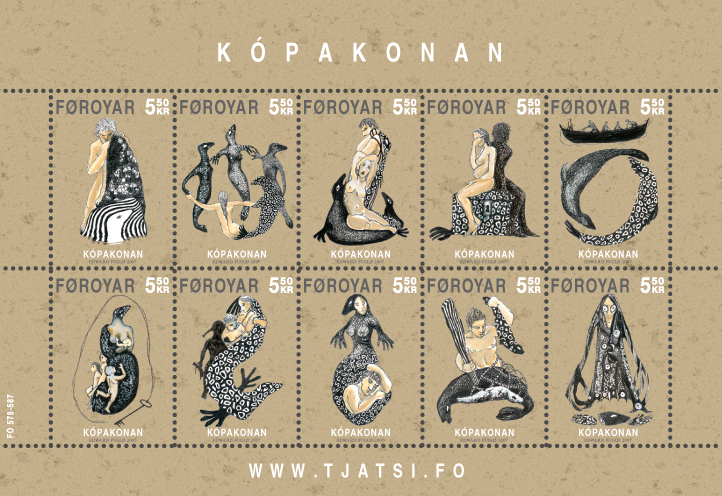
The legend of the seal-woman is well known in all the North Atlantic coastal regions.
Issue Date: 2/12/2007
Item No.: PPS000207
Value: 55,00
Date of issue: 12.02.2007 - Value: 10 x 5,50 DKK - Numbers: FO 578-587 - Stamp size: 30,0 x 43,0 mm - Sheet size: 174 x 120 mm - Printing method: Offset - Printer: Österreichische Staatsdruckerei, Austria - Postal use: Inland letters up to 20 g.
►
The Seal Woman
The legend of the seal-woman is well known in all the North Atlantic coastal regions. It is a moving story of a situation that people from all maritime cultures can recognise.
It touches on the great mysteries of life: love and betrayal, evil and death, beauty and wickedness, purity and faithfulness. There is a meaning in it for everyone, so it has always been popular. Even modern people are still fascinated by the haunting tale.
Two Faroese villages are particularly associated with the legend. The most famous version comes from Mikladalur on the island of Kalsoy, because this is the one reproduced by V. U. Hammershaimb in his Faroese Anthology in 1891. The story is also known from an ancient ballad. It is the tale of a farmer’s son from Mikladalur, who steals the skin of a young seal-girl, leaving her naked, so that she cannot return to the sea. She is forced to live as his wife for many years, until one day she finds her lost sealskin locked away. She puts it on and is able to return to her seal mate, who has been waiting for her all this time by the landing place. It is said that the descendants of the farmer’s son and the seal-woman have hands that look like a seal’s flippers. A similar version of the tale is told about the villagers from Hamar in Skálavík on Sandoy.
The version from Mikladalur ends in the worst imaginable tragedy. According to this legend, the men of the village decided to go seal hunting. The night before the hunt, the seal-woman returns in a dream to her husband and begs him to spare her mate and their two new-born seal pups. She tells him where they are sheltering in a breeding cave, so that he can recognise them. But instead of sparing them, the man finds and kills her mate and the pups. Then he cooks the meat for supper and eats it with his children. The seal-woman comes back once more, this time in the form of a fearsome she-troll, and warns them of her terrible revenge. Men will fall from the cliffs as they gather birds’ eggs, or drown while fishing, or die in other ways out in the wild elements, until there are enough of them to reach all the way round Kalsoy arm in arm. That number has still not been reached to this day.
This terrible ending is not known everywhere, and not in the version from the village of Skálavík, for instance.
In the broadest sense, this is a tale of humans and nature. Mother Nature gives, and takes back what she has given. Humans depend on nature, and should never defy its power. It is not for them to rule over Nature, and if anyone tries to do so, the consequences may be as disastrous as in the legend. It can also be regarded as a religious parable, as a warning not to challenge God, the creator who holds everything in his power.
The idea of the seal as a person comes naturally to those who live close to seals and are familiar with them. It is easy to imagine a human side to such beautiful, graceful creatures. Stories of familiar animals leaving their natural surroundings and appearing in human form are passed down everywhere in oral traditions and poetry.
Sadly, the moral of the story applies as much as ever to the way humans treat nature in our own time. Not surprisingly, many people still feel this fable is highly relevant. We are most deeply concerned about the threats of global warming and the climatic changes that will follow. The most pessimistic predictions are that nature’s revenge may be far more terrible than the seal-woman’s. Societies fighting for a cleaner environment and more respectful treatment of nature could perhaps make use of this Faroese legend in their campaigns.
Eyðun Andreasen