
in your cart

Total amount
Show cart
( items)

| Item No. | Vørunavn | Eind | Mynd | Prísur v/MVG |
|---|
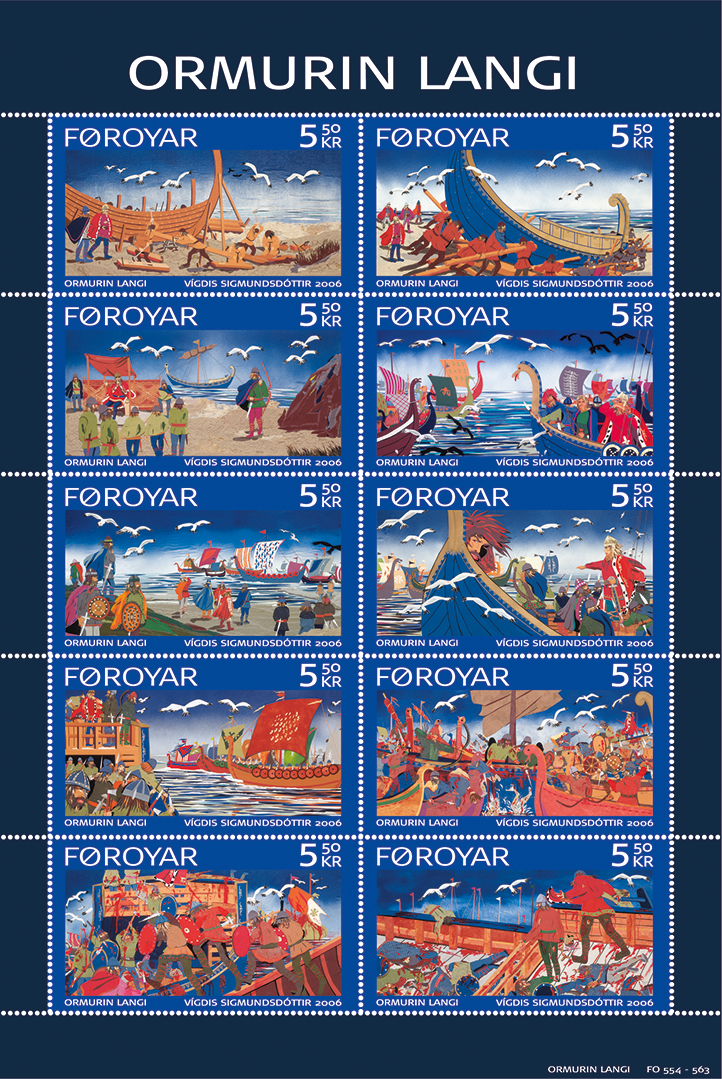
‘The Ballad of the Long Serpent’ takes its subject matter from the account well given in ‘Heimskringla’ of the famous sea battle off the island of Svolder or Swold in 1000.
Issue Date: 3/29/2006
Item No.: PPS020306
Value: 55,00
The Long
Serpent
Around 1800
we see an increasing amount of attention being paid to the store of Faroese
folk ballads, which survived in the oral tradition and were sung as an
accompaniment to Faroese dancing. Even
before 1800 J. C. Svabo had recorded ballads, but collecting got under way
seriously after 1800, and names like J. H. Schrøter, Jóannes í Króki and,
later, V. U. Hammershaimb can be mentioned in this regard. The old ballads were seen as having special
historical value, but there was also interest in more recent ballads, e.g.
comic ballads, and new ballads were composed in the old style. One poet who attracts particular notice is
Jens Christian Djurhuus (1773-1853), who was a farmer in
Kollafjørður. The most famous of his
works is ‘The Ballad of the Long Serpent’.
His most individual work, however, is perhaps ‘Púkaljómur (‘The Devil’s
Ballad’), a religious epic based on a Danish translation of ‘Paradise Lost’ by
the 17th-century English poet John Milton.
Otherwise he mainly takes the subject matter for his ballads from the
Norse sagas, e.g. ‘Heimskringla’ (‘The Chronicle of the Kings of Norway’) and
‘Færeyinga Saga’, the story of how the Faroes were converted to
Christianity. This was the Romantic Age,
and Norse literature was very much in vogue.
Everything indicates that the Faroese immediately took his poetry to
their hearts. In an account of a journey
written in 1847-48 the ballad collector and clergyman V. U. Hammershaimb
writes: “The old farmer Jens Christian Djurhuus of Kollafjørður has composed
many ballads based on the sagas. They
have been very successful and are sung everywhere with pleasure, since their
language is pure and they are very much in keeping with the old style; his
ballad about Olaf Tryggvason or the battle at Svolder, the ballads about
Sigmund and Leif, and his version of Milton’s Paradise Lost with its unusual
metrical structure are particularly worthy of note.”
‘The Ballad
of the Long Serpent’ takes its subject matter from the account well given in
‘Heimskringla’ of the famous sea battle off the island of Svolder or Swold in
1000, when the Swedish and Danish kings, together with the Norwegian Erik
Håkansson (Erik the Earl), attacked the Norwegian king, Olaf Trygvason, while
he was on his way home from Wendland to Norway on his ship, the Long Serpent,
accompanied by his fleet. They attack in
turn and King Olaf repulses the assaults of the two kings, but is defeated by
his countryman Erik Håkansson. The
outcome of the battle is known: when Olaf realises that the battle
is lost, he leaps overboard together with his surviving men. It is not known where this battle took place,
with it being doubtful whether there ever was an island called Svolder. In the ballad the poet has Olaf sailing from
the Baltic into the
Various
scenes from the drama described in the ballad appear on ten stamps. We see the shipbuilding and launch, the king
sitting on the throne while giving an audience to Einar the Archer, and we see
the fleet put to sea. We see the Long
Serpent and the other ships head into the straits while their adversaries stand
on the shore watching them. In the Long
Serpent’s bow we see Ulf the Red, Olaf’s forecastle man, while the king and
Erik the Archer are seen up on the quarterdeck.
We see dead bodies tumbling into the sea during the battle, which ends
with Erik capturing the Long Serpent and so taking command of the vessel.
We do not
know when ‘The Ballad of the Long Serpent’ was composed. The oldest recording dates back to 1819 and
was made by Jóannes í Króki of Sandur.
He also records it in 1823 in ‘Sandøbogen’, his large collection of
ballads, together with the information that he had the ballad from the poet
himself. When Svend Grundtvig and Jørgen
Bloch edited ‘Føroya kvæði’, an anthology of Faroese folksongs, around 1880,
they knew of six recordings of the ballad.
A recording in the poet’s own hand turned up at a later date, but we do
not know when it dates from.
Nowadays
the ballad is only every referred to as ‘Ormurin Langi’, i.e. ‘The Long
Serpent’, but that was not the title used by the poet himself. He called it ‘Olaf Trygvasons kvad’ (‘The Ballad
of Olaf Trygvason’), and we find the same title used by other recorders,
including Jóannes í Króki. It is also
the title used in ‘Føroya kvæði’. It is
not until a recording of 1846 that we find the ballad being named after the
ship (‘Kvæðið um Ormin langa’). When
Hammershaimb had the ballad printed in his principal work, ‘Færøsk Anthologi’
(‘A Faroese Anthology’) of 1891, he used the title ‘Ormurin langi’, and the
same title was used when it was serialised a few years earlier (1882) in the
Dimmalætting newspaper. The text of the
ballad varies slightly from recording to recording, but when the ballad is
performed today, it is always in the form known from ‘Færøsk Anthologi’. Nor do the old recordings agree on which
refrain (and therefore which tune) to use.
The refrain that reigns supreme today is only found in one of the oldest
recordings. It is the one used in
‘Færøsk Anthologi and is, incidentally, familiar from some of the old
ballads. ‘Færøsk Anthologi’ has had a
standardising effect and its text has in some ways become the authorised
version.
It would be
no exaggeration to say that the ballad has become national property. All the Faroe islanders know it, it is read
and taught assiduously in schools, and most people – or at least those interested
in Faroese dancing – can sing along when it is performed for a dance. It is well composed, the narrative is lively
and hangs together logically, and the poetic language is powerful.