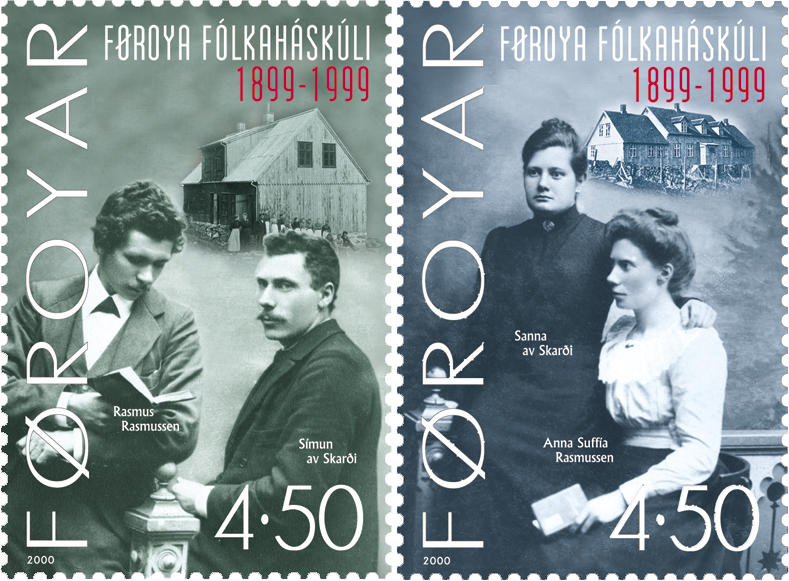
The Faroese Folk High
School, - 1899-1999 - FR 364-65
On
Boxing Day in 1888, many peopled gathered in the courthouse in Tórshavn. The
weather was bad – it was raining and stormy, and the roads were impassable,
making it difficult to get to the capital from the other districts and islands.
Nevertheless, the courthouse was packed. The occasion of the meeting was that
there had been the following small notice in the paper Dimmalætting on 22
December: “Everyone is invited to come to the courthouse on Boxing Day at 3 pm
where we will be discussing how to defend the Faroese language and Faroese
culture”. The conveners of the meeting were a circle of poets and other
intellectual leaders. At this famous Christmas meeting, the poem “Sprogstrid'
(Language Dispute), written by the 22-year-old Jóannes Patursson of Kirkjubøur,
was read out. The poem starts with an appeal that the time has now come in this
country to join hands in working to promote the Faroese language.
Speeches were made, and many people held the floor. In the end, the
participants agreed on a resolution in accordance with which the mother tongue
was to have greater rights in schools, the Church and in all public affairs,
and importance was to be attached to the history of the Faroe Islands in the
history taught at schools. The resolution also stated that work was to be done
to found a Faroese folk high school. In January the following year, the Faroese
Society was founded. The objects of the society were as follows: 1. To achieve
distinction and rights for the Faroese language, 2. To make the Faroese stand
together and develop in all areas so that they can manage on their own. With
these declarations of intent, the new national movement had staked out the
course which has now been followed for more than a century. From the
Reformation, the liturgical language had been Danish, and, with the
introduction of a Faroese educational system in the nineteenth century, Danish
became the language of instruction. Faroese did not have any rights as a school
subject, and several generations of Faroese could not write their own language.
A Faroese folk high school could, independently of the official educational
system, pave the way for education with a Faroese content.
The
folk high school idea is Danish. It has its origin in representative
government, which replaced absolutism in 1848. N.F.S. Grundtvig had the view
that if the people were to participate in the government of the Kingdom, they
had to have better enlightenment than that which could be acquired in primary
schools. The people were to learn about themselves – their own history and
culture. But this was not to take place in accordance with the methods
practised in higher education at learned educational establishments. Not
everyone was to be a scholar. Instead of books and rote learning, Grundtvig and
Christen Kold, who were to implement the idea, put their faith in the spoken
word promoted with enthusiasm and zeal in the mother tongue.
The folk high school movement aroused great interest on the Faroe Islands, and,
from the 1870s, a large number of Faroese had been students at Danish folk high
schools. It was, in particular, popular to visit Vallekilde højskole. But at
these folk high schools, the basis was, of course, the Danish language, history
and literature. Both Faroese and Danish high school people, who had great
appreciation for the popular revival of the Faroese, realised that if the
Faroese national movement was to have a future, a Faroese folk high school,
based on a popular Faroese foundation, had to be established.
Two young Faroese decided to work for this cause: Símun av Skarði and Rasmus
Rasmussen. Símun av Skarði (1872-1942) was born in the small village of Skarð
on Kunoy. At the teacher training college in Tórshavn, he met Sanna Jacobsen
from Tórshavn; they both took the Teacher’s Certificate Exam in 1896 and became
engaged. Already at this point, Símun had decided that he did not want to work
in the primary school system – together they were to found a folk high school
and attract young Faroese. The same year, Símun av Skarði went to Askov højskole.
Rasmus Rasmussen (1871 - 1962) from Miðvágur on Vágar went to Vallekilde
højskole in 1892, where he stayed for 2 years. He then went to Askov højskole.
Here he met Símun av Skarði for the first time, and, of course, the latter
initiated him in his plans to found a folk high school on the Faroe Islands.
They agreed to work together, and they started studying for the task. For two
winters and two summers, they were students at Askov højskole, and they then
studied for a year at the National Post-graduate Teacher Training College,
Statens Lærerhøjskole, in Copenhagen. Símun studied history and languages in
particular, Rasmus studied natural history and mathematics.
Føroya
Fólkaháskúli started in the winter of 1899 in temporary premises in Klaksvík,
made available by a grocer. Rasmus married Símun’s sister Anna Suffía av
Skarði. She was responsible for the housekeeping during the first years. The
same year the building of the folk high school began. They found a suitable
place on a scenic stretch of coast west of Klaksvík under an escarpment. They
named the place Fagralíð (the beautiful hillside). Rasmus, who was a trained
carpenter, built the building together with other men from Nordøerne, and the
following winter the house was finished, but the students could not come until
28 November. The same summer Sanna av Skarði went to Vallekilde højskole to
become proficient in housekeeping and needlework so that she could be in charge
of the housekeeping and teach at Fagralíð højskole.
There were many obstacles to overcome, and hard work was needed. The financial
situation was very difficult, but the idea had wide support in the population.
Everywhere the young idealists were met with a positive attitude to the folk
high school. Money was collected throughout the country, and the folk high
school had many friends. The surroundings of the folk high school were scenic
and idyllic – together with the students the teachers could fish in the fjord
in the evening and go for walks in the mountains. This was possible as long as
the teachers were young and strong, but having the folk high school in such a
remote place also turned out to be highly impractical. There was no road
communication – all goods, for example coal, had to be freighted by rowing boat
or be carried on the back all the way across the mountain from Klaksvík. It
became necessary to move the folk high school to Tórshavn. In 1909, the
building was dismantled and rebuilt a fair bit west of the capital, and the
folk high school has been located here ever since. The town has sprawled in all
directions, and Færøernes Folkehøjskole now stands in the centre of the town.
Conditions were cramped during the first years, but from the 1950-1960s the
school has been extended considerably, it has acquired a spacious dining hall,
kitchen, gymnasium and modern rooms. In the 1980s, the school was further
extended with two neighbouring buildings. The current principal of the folk
high school is the philosopher and poet Rói Patursson (born 1947).
The
folk high school has been of great importance to Faroese popular identity.
During the first three decades, this was the only place where the people could
receive in-depth teaching in the Faroese language, literature and history, and
here services were held in Faroese with Faroese hymns. The public educational
system was reluctant to relinquish its Danish identity, but it was gradually
greatly influenced by the spirit of the folk high school. The folk high school
has perhaps been of greatest importance in this respect. During the past three
decades, it can be said that the official educational system has at last
acquired a Faroese identity, but the small Faroese people is facing large
challenges in the information society of today, and there is still a need for a
living folk high school.